Event Wristbands Make Attendance More Visible While Mobile Tickets Make Entry More Convenient
By Kato Tam
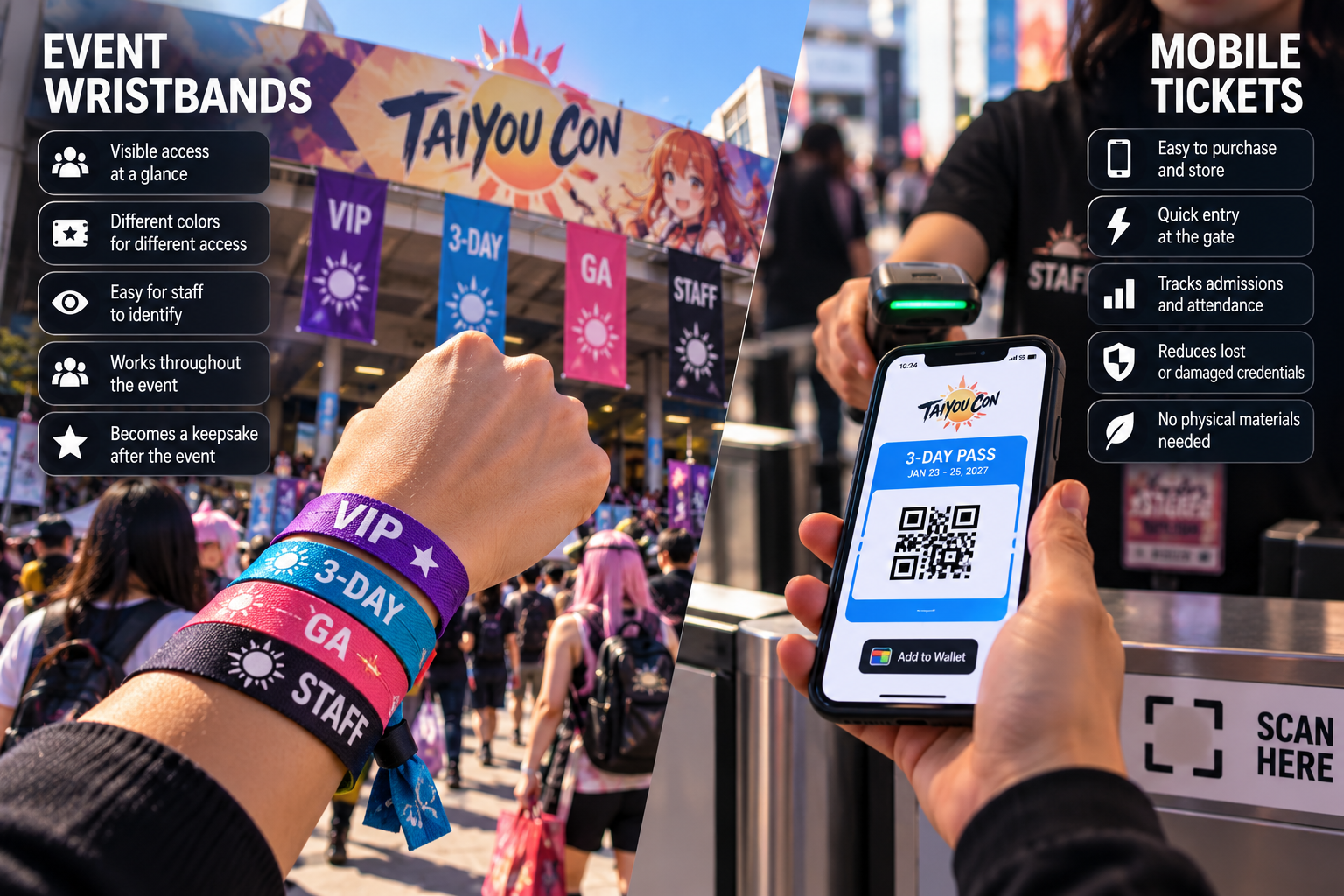
Walking into a festival with a wristband feels different from entering with a ticket on your phone. Both prove that you belong at the event, but only one continues to communicate that after you walk through the entrance.
A mobile ticket is designed to complete a transaction. You purchase admission, receive a digital credential, show it at the gate, and move on. Once the ticket has been scanned, it often disappears from the experience unless you need to show it again.
A wristband stays with you.
At music festivals, conventions, and other large gatherings, wristbands do more than verify admission. Their colors can distinguish ticket types, identify access levels, and help staff recognize who belongs in particular areas without asking everyone to open an app.
The difference is that a mobile ticket proves entry, while a wristband can continue proving access.
That becomes especially noticeable at events where attendees move between multiple spaces throughout the day. A staff member checking access to a premium seating area can often identify the appropriate wristband with a glance. Someone using a mobile credential may need to retrieve their ticket, adjust their screen brightness, or wait for another scan.
Neither process is necessarily difficult, but repeated small interactions can change how smoothly an event feels.
For organizers, the differences extend beyond convenience.
Digital tickets can provide useful information about purchases, admissions, and attendance. Organizers may be able to see which tickets have been scanned, how many attendees have arrived, and whether a credential has already been used.
Wristbands provide a different advantage. They allow staff to recognize attendees without requiring every interaction to involve a device.
The two systems solve different operational problems.
A mobile ticket is particularly useful before arrival because it can be delivered immediately, stored electronically, and checked against an event's ticketing records. A wristband becomes useful after arrival because it is visible and remains attached to the attendee.
An event's entry system is not necessarily the same as its access-control system.
This distinction also affects how attendees experience the event itself. A digital ticket may live in an email or mobile wallet, while a wristband becomes something people physically wear throughout the day.
That visibility can create a subtle sense of participation.
At a festival, a colorful wristband can identify someone as part of the same crowd. At a convention, badges and wristbands can distinguish attendees, exhibitors, guests, and staff. Even outside the venue, those credentials can become small signals of a shared experience.
A ticket on a phone usually does not have the same social presence.
There is also a difference in what people keep afterward.
Some attendees save their wristbands long after an event ends. They may collect them alongside concert tickets, convention badges, or other souvenirs. A digital ticket can preserve the same date and event information, but it does not automatically become an object someone can display.
That does not make physical credentials better in every situation.
Wristbands require materials, distribution, and sometimes replacement when damaged or lost. Digital tickets can reduce some of those needs while making advance purchases and admission tracking easier.
The more interesting question is whether organizers should expect one format to perform every function.
For a single-entry event, a mobile ticket may be all an attendee needs. For a multi-day festival with different access areas, a physical credential may continue serving a useful purpose after the original ticket has been scanned.
Some events benefit from combining both approaches.
Attendees purchase and present digital tickets at entry, then receive wristbands or badges that remain visible during the event. The technology handles admission records while the physical credential helps people navigate the experience.
What appears to be a simple choice between paper, plastic, and smartphones is really a choice about how admission should work before, during, and after an event.
Mobile tickets are excellent at getting people through the entrance.
Wristbands can help make the rest of the event work.