AI Dubbing Lets You Watch Anything, But You'll Miss What Made It Great
By Kato Tam
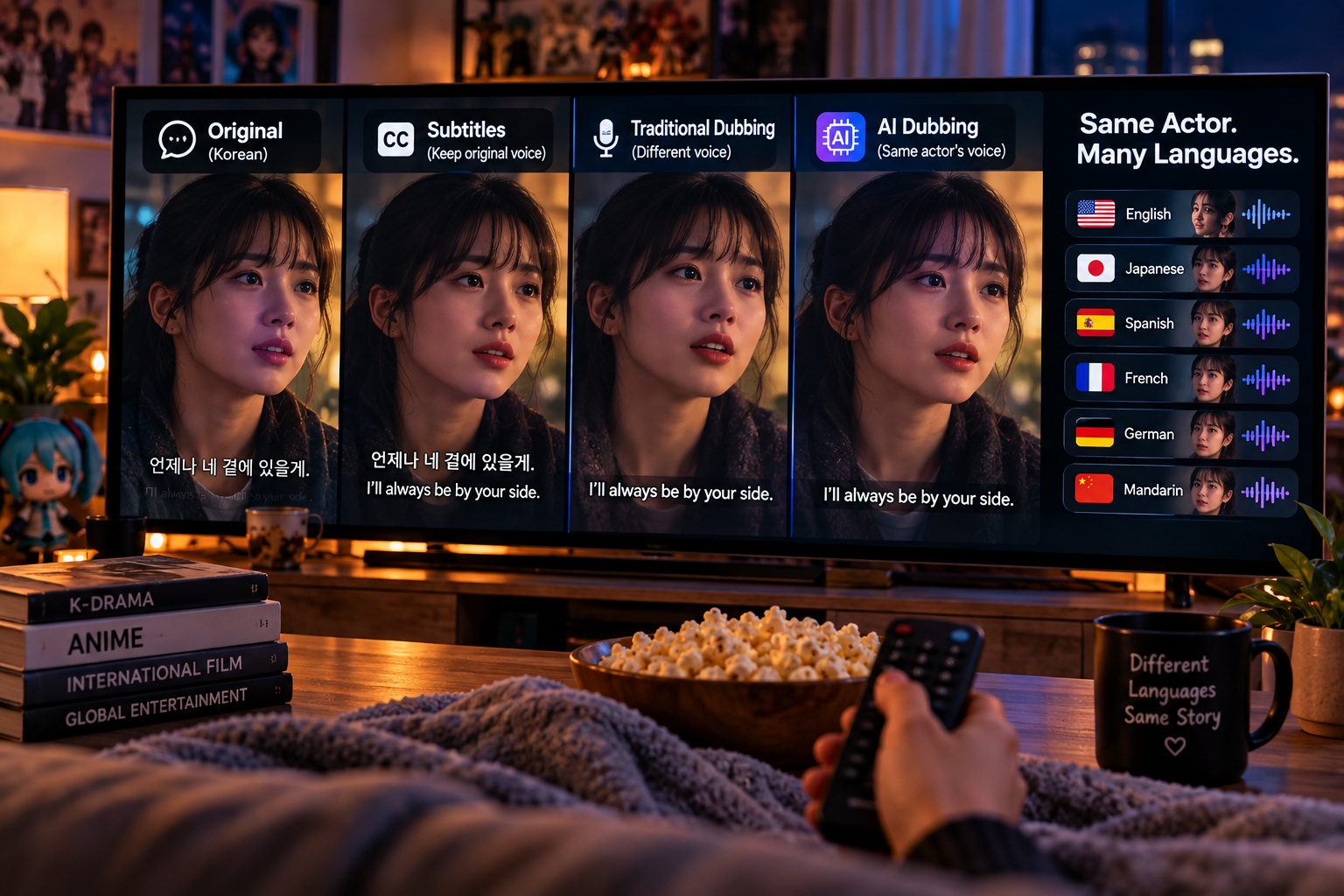
For decades, watching entertainment from another country usually meant accepting a tradeoff: read subtitles and hear the original actors, or watch a dubbed version performed by a different cast.
AI dubbing is starting to create a third option. Instead of simply replacing one language with another, technology can increasingly preserve elements of an actor's original voice while making that actor appear to speak a language they never recorded.
That sounds like a better version of traditional dubbing.
A Korean actor could theoretically sound more like themselves in English. An English-speaking creator could reach Spanish-speaking viewers without recording an entirely separate performance. Smaller productions that could never afford several professional dubbing casts could suddenly reach audiences around the world.
AI dubbing can preserve the identity of a voice while changing the performance inside it.
That distinction matters because a voice is more than its sound. Acting lives in pauses, emphasis, rhythm, hesitation, volume, and the tiny choices someone makes while delivering a line.
Translation already has to interpret some of those choices.
A joke that works perfectly in Japanese may need different wording in English. A sentence that takes three seconds in one language might take five in another. Even the level of politeness between two characters can carry information that does not translate neatly.
Traditional dubbing deals with that problem by asking another performer to interpret the translated version.
AI approaches the problem differently. If the goal is to preserve the original actor's vocal identity, the translated performance can sound closer to the person on screen even though that person never actually delivered those words.
That creates a strange new category of performance.
The voice can belong to the actor while the acting choices increasingly belong to a system.
For viewers, the advantages are obvious. Subtitles require attention to the screen, traditional dubs can sound disconnected from the original cast, and some people simply prefer watching entertainment in a language they understand.
AI could make international entertainment much easier to cross those boundaries.
But accessibility and authenticity are not necessarily the same thing.
Imagine an actor delivering a quiet line with a very specific hesitation. An AI dub might translate the words accurately and recreate the actor's voice convincingly, yet slightly change the timing that made the original scene work.
Most viewers might never know anything changed.
That is what makes AI dubbing more interesting than simply asking whether it sounds realistic. The more convincing the technology becomes, the less obvious the distance between the performance someone actually gave and the version we receive.
Traditional dubbing makes that distance visible because we know another actor is performing the translated dialogue.
AI can make it disappear.
That could make foreign entertainment feel more accessible than ever while creating a new question about what we consider the original performance.
We may eventually watch the same actor speak ten languages and feel as though we heard the same performance ten times.
Technically, we may have heard ten different interpretations wearing the same voice.