Asking AI Gives a Different Kind of Answer Than Searching Google
By Kato Tam
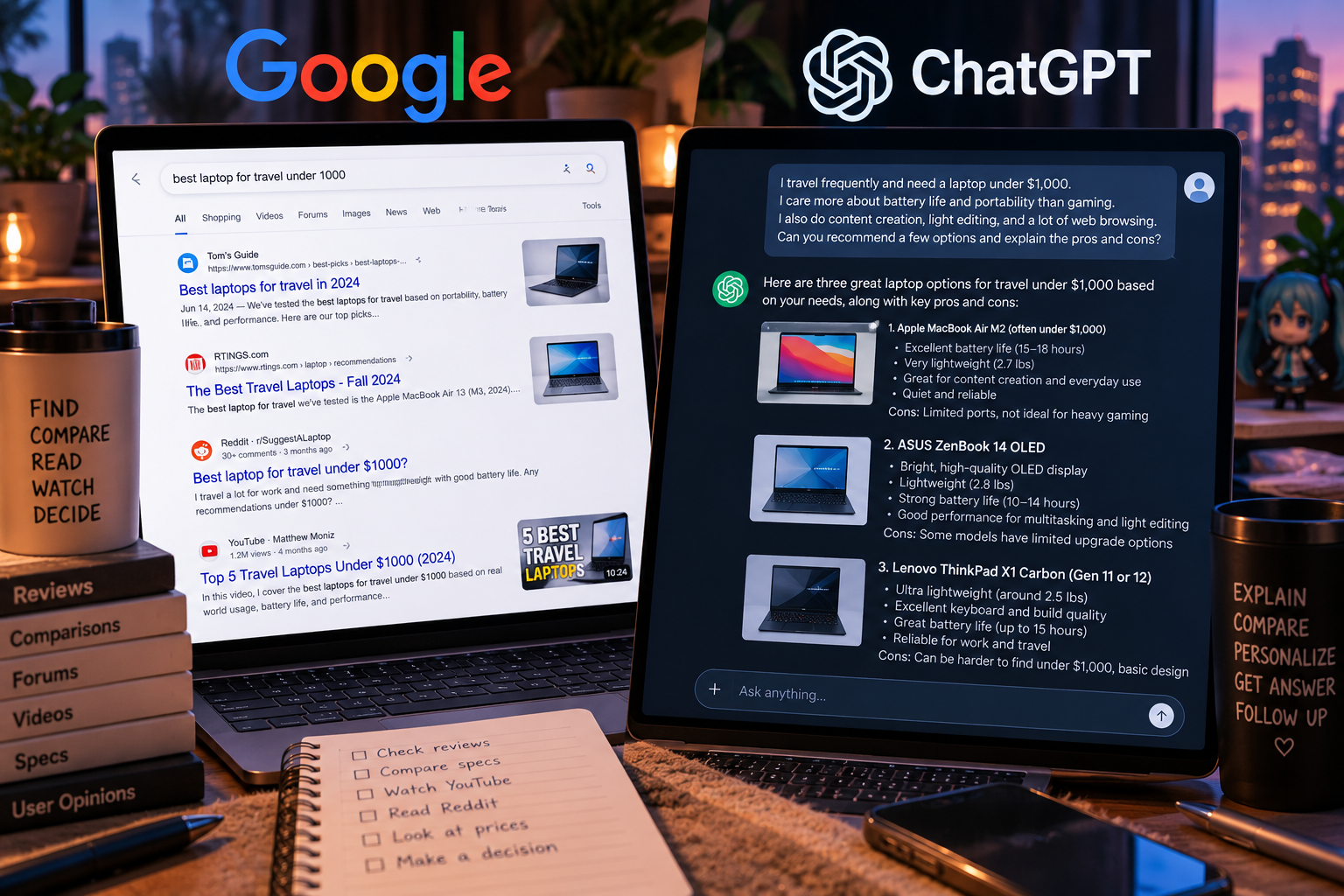
Searching Google and asking an AI can start with the exact same question, but they encourage two very different ways of looking for an answer.
Google trained us to think in keywords. If the first search did not work, we changed a word, added another detail, opened a few results, and slowly narrowed the search until we found what we needed. Getting the answer was partly a research process.
AI asks us to do almost the opposite.
Instead of breaking a question into search terms, we can explain the entire situation. We can include the weird exception, describe what we already tried, and ask a follow-up without starting over. The better we explain the problem, the more useful the answer can become.
Search made us good at finding information. AI is making us good at describing what we actually want to know.
That difference becomes obvious with questions that do not have one clean answer. Searching for the best laptop, for example, usually gives you reviews, retailer pages, Reddit discussions, videos, and comparison articles. You still have to decide which information matters to you.
Ask an AI and the experience is reversed.
You might say you travel frequently, care more about battery life than gaming, hate carrying heavy computers, and want to spend less than $1,000. Instead of giving you a page of places to investigate, the AI can take those preferences and turn them into a recommendation.
That convenience changes the role we play in the process.
With search, we are usually the ones gathering information and assembling the answer. With AI, we increasingly hand over some of that assembly and receive something that already looks finished.
A finished answer feels different from a collection of sources.
Google constantly reminds us that information came from somewhere else because the search results are visibly made of websites. An AI response can make those boundaries less obvious. Several sources, assumptions, and pieces of reasoning can arrive as one smooth explanation.
That can make AI dramatically faster, but it also creates a new habit worth noticing.
When Google gives me ten links, I know I still have work to do. When AI gives me ten paragraphs, it is much easier to feel like the work has already been done.
Neither approach is automatically better.
Sometimes I want the original restaurant menu, government form, product specification, research paper, or news report, and search is a much more natural path to it. Other times I have a messy question that would take six searches to explain, and having a conversation with AI is far more useful.
The interesting change is that we are no longer only choosing where to find information.
We are choosing whether we want to investigate the information ourselves or begin with an answer that has already been assembled for us.
That is a much bigger change than replacing a search box with a chatbot.